Press Release
Commencing Demonstration Operations of Plant Combining Rock Thermal Energy Storage and Energy Management Technology ~Contributing to resolving the supply-demand gap for electricity and heat through demonstration operation conducted at the first scale in Japan~
October 14, 2026
Toshiba Corporation
Chubu Electric Power Co., Inc.
Shin Tokai Paper Co., Ltd.
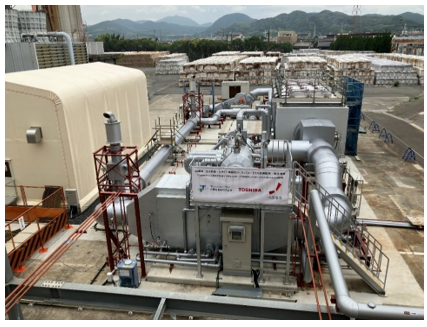
Toshiba Corporation (hereinafter "Toshiba"), Chubu Electric Power Co., Inc. (hereinafter "Chubu Electric Power"), and Shin Tokai Paper Co., Ltd. (hereinafter "Shin Tokai Paper") have just begun a full-scale demonstration operation of a plant that combines rock thermal energy storage with a thermal capacity of approximately 10 megawatt-hours (Note 2), which is the first scale in Japan (Note 1), and energy management technology (hereinafter the "Rock Thermal Storage EM Facility"), installed at Shin Tokai Paper's Shimada Mill (Shimada City, Shizuoka Prefecture).
The technology demonstration test using the Rock Thermal Storage EM Facility (hereinafter "this technology demonstration test") was selected by the Ministry of the Environment for its "FY2024 Technology Development and Demonstration Project for Regional Symbiosis and Cross-Sectoral Carbon Neutrality (Technology demonstration of rock thermal energy storage plants and development of a large-scale thermal energy management model suitable for local communities)."
In recent years, renewable energy, primarily from naturally fluctuating sources such as solar and wind power, has adopted and expanded. This growth has made addressing the gap between electricity supply and demand a major challenge. Furthermore, in the domestic industrial sector, thermal energy such as steam and hot water is widely used in manufacturing processes; however, the timing of heat demand generation at facilities like factories does not always align with the timing when electricity can be effectively utilized. In order to solve this challenge, attention has been given to a "thermal energy storage technology (heat storage technology)" that achieves stable energy supply and efficient energy use by storing excess electricity as thermal energy in thermal storage materials such as rock, molten salt, and concrete, and providing heat or generating electricity as needed. In particular, "rock thermal energy storage" uses natural rock as the heat storage material; as a result, it is expected to be a technology with lower environmental impact and lower costs, as well as higher safety, compared to conventional energy storage technologies such as lithium-ion batteries.
Toshiba, Chubu Electric Power, and Shin Tokai Paper, together with Shimada City, concluded a cooperation agreement in 2024 to promote the demonstration of rock thermal energy storage technology, and have been promoting the construction and operation of the Rock Thermal Storage EM Facility, as well as simulation verification of energy management regarding energy balance and CO2 emission reduction effects in Shimada City (Note 3).
In the Rock Thermal Storage EM Facility used in this technology demonstration test, electric heaters are operated according to the electricity supply-demand balance within the Shimada Mill, and the heat is stored in a thermal storage tank filled with rock thermal storage material. In order to supply the stored heat to the Shimada Mill at the optimal timing, energy management technology calculates the optimal heat storage and heat release timing according to the heat storage state and the heat demand within the mill, and automatically controls the steam generator, electric heater, blower, etc., of the Rock Thermal Storage EM Facility. As a result, the required amount of heat is supplied at the required timing and used as steam in the drying process of paper manufacturing.
In this technology demonstration test, Toshiba will use its proprietary energy management technology (Note 4), which integrates the operation planning, simulation, and automatic control of the Rock Thermal Storage EM Facility, as well as its Reduced Order Model (ROM) technology (Note 5), which predicts temperature distribution inside the thermal storage tank at high speed and with high accuracy. These technologies will be used to verify the operability of the Rock Thermal Storage EM Facility and the effect of reducing CO2 emissions at the Shimada Mill.
Chubu Electric Power will verify the structural integrity of the 700°C-class thermal storage tank, which is an extremely high temperature for concrete structures, and conduct market research to promote the introduction of rock thermal energy storage and energy management technology.
Shin Tokai Paper will promote efforts toward decarbonization by effectively utilizing clean electricity derived from biomass power generation within the Shimada Mill in accordance with the heat demand within the mill.
Through this technology demonstration test, Toshiba, Chubu Electric Power, and Shin Tokai Paper will accelerate efforts toward the practical application of rock thermal energy storage technology in order to contribute to resolving the supply-demand gap for electricity and heat.
(Note 1) As a rock thermal energy storage facility combined with energy management technology, a facility with a thermal capacity of approximately 10 megawatt-hours is the first in Japan (surveyed by the three companies)
(Note 2) This is equivalent to the electricity consumption of approximately 880 households in one day
(Note 3) November 13, 2024 Press Release: "Basic agreement on collaboration to promote technical demonstration of a plant using technology for rock thermal storage and energy management - Contribute to bridging the gap between electricity supply and demand caused by the expansion of renewable energy deployment -"
(Note 4) It was developed as part of Toshiba's "TOSHIBA SPINEX for Energy" service lineup, which is offered to electric utilities and manufacturers
(Note 5) This technology involves using machine learning to process data obtained from experiments and detailed numerical analyses, thereby constructing simplified models that enable simulation calculations, which previously required significant computational time using conventional high-precision models, to be performed with high speed and high accuracy.
External view of Rock Thermal Storage EM Facility